Facts checked Article
Casino software studios
What are the leading suppliers of online slot games? What the published test reports establish
No UK regulator ranks slot studios. The Gambling Commission lists 14 approved test houses and sets the fields every game test report must name, both read 23 September 2026.
The question — "what are the leading suppliers of online slot games?" has no published answer
No public UK document ranks slot studios. Readers ask what the leading suppliers of online slot games are, and no regulator answers that question.
What the Gambling Commission does publish is narrower. It names the test houses it approves. It also sets out what a game test report must contain.
So a claim about one game can be checked against a document. A claim that one studio leads the field cannot. Both Commission pages here were read on 23 September 2026.
The nearest published answer is a list, not a ranking. This site keeps a documented index of fifteen studios, each with its own legal entity and register entry. What follows is the other half: what a testing claim about any of them proves.
Sources: Gambling Commission: approved test houses; Gambling Commission: procedure for testing.
What the two Commission pages settle
- Approved test houses listed
- The Commission list is headed 'Test Houses approved by the Gambling Commission as of 2 March 2026' and carries 14 rows.Gambling Commission: approved test houses · as checked on
- Who must use one
- 'Where third party testing is required by the testing strategy, Licensees must appoint an approved Test House from the following list.'Gambling Commission: approved test houses · as checked on
- When a game may go live
- 'All new games and RNGs can only be released once the testing has been completed and the report provided to the Commission.'Gambling Commission: procedure for testing · as checked on
- What no page carries
- No ranking of studios, and no list of which games any one studio has had tested.Gambling Commission: approved test houses · as checked on
Wording read on 23 September 2026. Counts are ours, taken from the rows on the page.
Approved test houses — the Commission names 14
Where outside testing is needed, the licensee must pick a firm from one list. The Commission publishes that list and keeps it current. It was last updated on 4 September 2026.
The list carries 14 rows, read on 23 September 2026. Of those, six rows are GLI companies and two are BMM companies. Each row says whether the firm may test against the remote standards.
The list is not a ranking. Instead it records which firms may test, and for what kind of work. A test house on it is not a studio, and it does not make games.
Sources: Gambling Commission: approved test houses.
The 14 approved test houses, and what each may test
| Test house (trading name) | Remote technical standards | Categories of gaming machines | Bingo and casino equipment | Evidence |
|---|---|---|---|---|
| BMM Testlabs (South Africa) | Yes | All categories (except cat B3a and compensated versions) | No | · Gambling Commission: approved test houses |
| BMM Spain Testlabs SL | Yes | All categories | Yes | · Gambling Commission: approved test houses |
| eCOGRA Limited | Yes | None | No | · Gambling Commission: approved test houses |
| Gaming Associates Europe Limited | Yes | None | No | · Gambling Commission: approved test houses |
| Gaming Laboratories International (GLI), LLC | Yes | All categories | Yes | · Gambling Commission: approved test houses |
| GLI Europe BV | Yes | All categories | Yes | · Gambling Commission: approved test houses |
| GLI Africa (Pty) Limited | Yes | All categories | Yes | · Gambling Commission: approved test houses |
| Gaming Laboratories International, India PVT Ltd | Yes | None | Yes | · Gambling Commission: approved test houses |
| GLI UK Gaming Limited | Yes | All categories | Yes | · Gambling Commission: approved test houses |
| GLI Gaming Laboratories Ltd | Yes | All categories | Yes | · Gambling Commission: approved test houses |
| Global Lab Limited | Yes | None | No | · Gambling Commission: approved test houses |
| Nick Farley & Associates, Inc (Eclipse Compliance Testing) | Yes | All | Yes | · Gambling Commission: approved test houses |
| Quinel Ltd | Yes | None | No | · Gambling Commission: approved test houses |
| RiskCherry | Yes | None | No | · Gambling Commission: approved test houses |
Six of the 14 rows are GLI companies and two are BMM companies. That is our count of the rows, not a Commission statement.
The testing path — who tests, and when
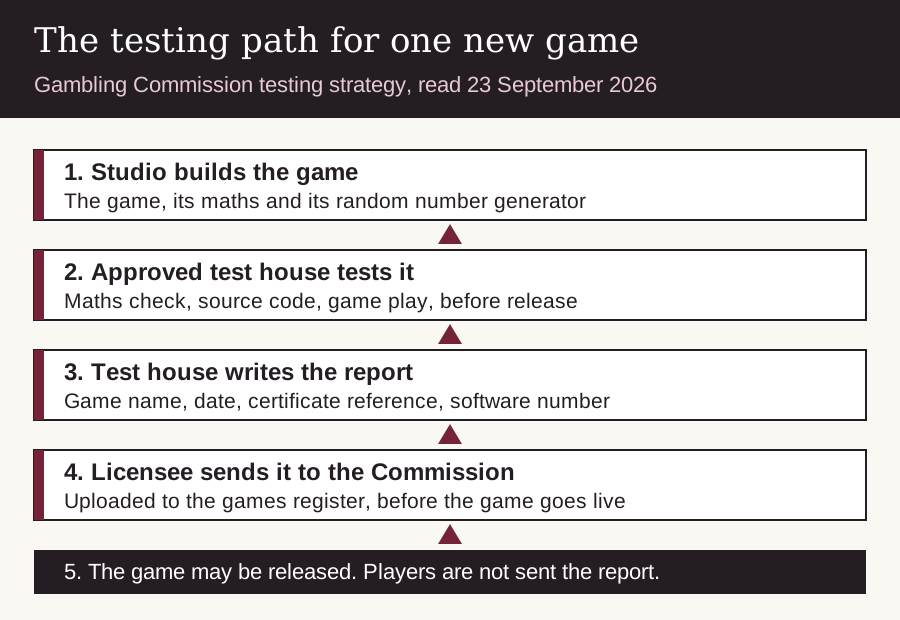
A new game is tested before it goes live. The test house starts with the random number generator, the part that picks outcomes. It reads the documents, reviews the source code and tests the raw output.
It also looks for known weaknesses in the algorithm or the hardware. Where it finds a fault, the fault goes back to the supplier. The test house then checks the fix before that work can pass.
Next it checks the game itself. The strategy names maths verification, source code analysis and game play. The aim is to see whether the game runs by its published rules.
That game work has two halves. One is the design: the maths, the artwork, the rules shown to players and the theoretical RTP. The other is the software that carries out that design on a setup like the live one.
The test house writes a report and gives it to the licensee. The licensee sends that report to the Commission games register before release. The register is a Commission system, not a public page.
Sources: Gambling Commission: procedure for testing; Gambling Commission: testing strategy, approach.
Report fields — what one test report names
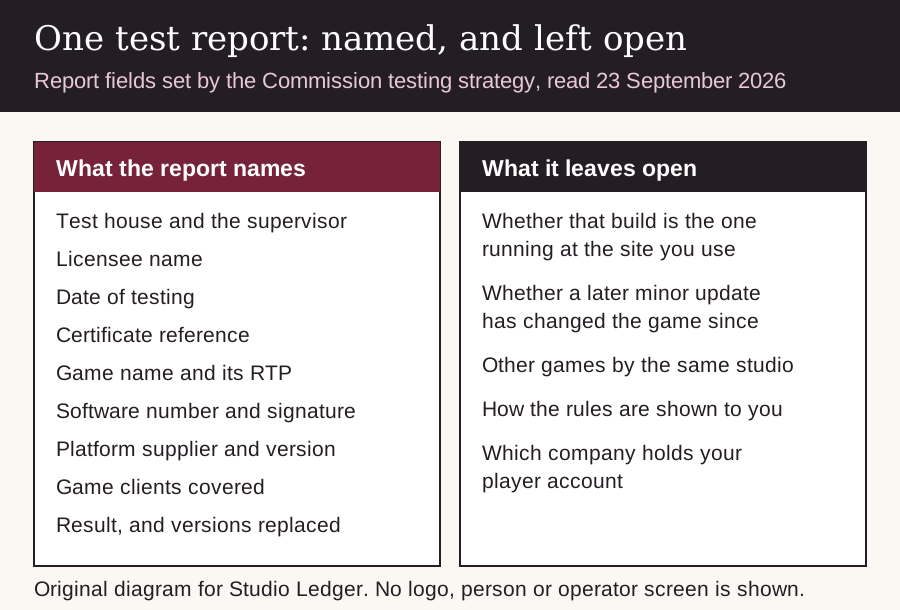
The strategy sets out what a games report must contain. The list is long and very specific. That is why a testing claim with no date and no game name means little.
A report names the test house and the supervisor who signed the testing off. It names the licensee, the date of testing and a certificate reference. It names the game, its return to player percentage, its software number and its digital signature.
It also names the platform supplier and version, the game clients covered and the result. Return to player, or RTP, is the share of stakes a game is built to pay back over very many plays.
Sources: Gambling Commission: procedure for testing.
Ten fields a games test report must carry
The Commission's own list for game reports, read 23 September 2026. An RNG report carries a shorter list of its own.
Ticks are kept only in this browser and are never sent anywhere.
Scope — what a test house is not asked to check
A report is bound to one build of one game. So it says nothing about the rest of a studio's catalogue. It says nothing about the site you are using.
The strategy is plain about one limit. Test houses are not expected to assess how game rules are made available to players. They do review the rules the game displays, to see they match the maths.
So a badge on a studio page is not a report. Ask which game, which build and which date. Then ask who holds your account, because that is a separate licence.
Sources: Gambling Commission: testing strategy, approach.
The limit the Commission sets on game rules
While test houses aren't expected to assess how game rules are made available to players (rules easily accessible via hyperlinks etc), it is expected that they review the game display and content of player facing rules to see they accord with the maths and enable players to verify game outcomes.
Licence type — a software licence does not cover your account
The firm that made a game and the firm that holds your money are not the same licensee. The Commission is direct about this. A gambling software licence 'only authorises the manufacture, supply, installation and adaptation of gambling software'.
The same page adds the limit. That licence 'does not permit the provision of facilities for gambling'. So a studio with a software licence cannot take your bet.
Read the two roles as two rows. One row is the studio and its software licence. The other is the site, its operating licence and its own terms.
Sources: Gambling Commission: what is gambling software.
Two licences, two roles
- What gambling software is
- 'Computer software for use in connection with remote gambling', excluding software used solely with gaming machines.Gambling Commission: what is gambling software · as checked on
- What the licence authorises
- 'the manufacture, supply, installation and adaptation of gambling software'.Gambling Commission: what is gambling software · as checked on
- What it does not authorise
- It 'does not permit the provision of facilities for gambling', so a software licensee cannot take your bet.Gambling Commission: what is gambling software · as checked on
Wording from the Commission's gambling software guide, read 23 September 2026.
Updates — a minor change can ship untested
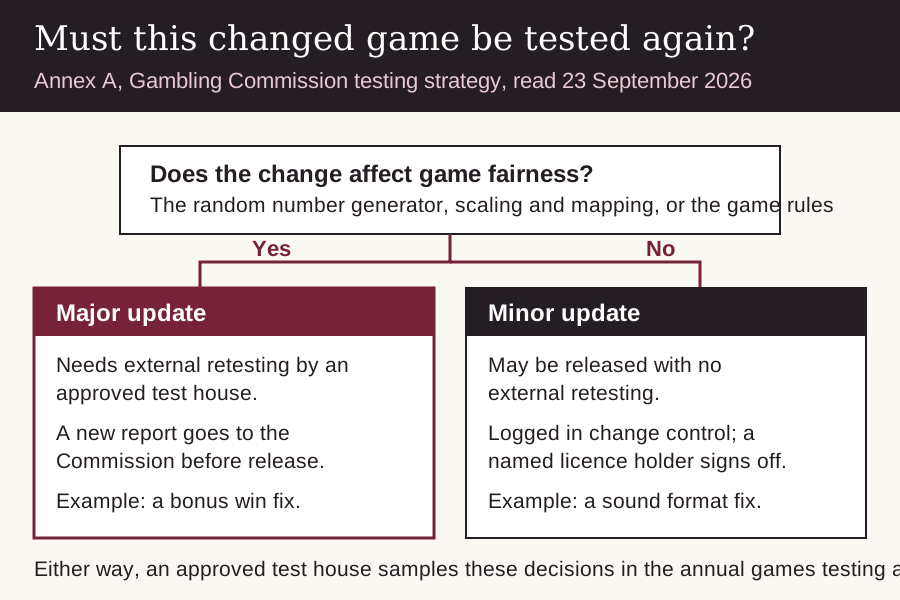
Not every change goes back to a test house. The strategy calls a change major when it may affect the fairness of a game. That covers the random number generator, scaling and mapping, and the game rules.
Everything else is a minor update. A minor update can be released without the need for external retesting. The published examples include a sound fix for a phone update and a button out of line.
Minor changes are still recorded. A named personal management licence holder is responsible for the process. An approved test house then samples those calls once a year.
Sources: Gambling Commission: Annex A, major and minor updates; Gambling Commission: procedure for testing.
Major and minor updates, with the Commission's own examples
| Kind of change | What it means | Published example | Evidence |
|---|---|---|---|
| Major update | 'any software change which may affect the fairness of a game', covering the RNG, scaling and mapping, or game rules | A win calculation inside a game feature, corrected for a rare case | · Gambling Commission: Annex A, major and minor updates |
| Major update | Needs external retesting by an approved test house before release | A logging fix that changed how the game built its symbol arrays | · Gambling Commission: Annex A, major and minor updates |
| Minor update | 'All updates which do not fall within the definition of major update' | A sound format change so games play on a newer phone system | · Gambling Commission: Annex A, major and minor updates |
| Minor update | 'can be released without the need for external retesting' | A stake selection box not displaying fully in one browser | · Gambling Commission: Annex A, major and minor updates |
The line is game fairness, not how big the change looks. A performance fix that rebuilds how the game handles symbols is a major change.
The annual audit — what a test house checks once a year
Some licensees must have an annual games testing audit. It applies to firms with a gambling software licence that also carry certain remote operating licences. The audit has to be done by a Commission approved test house.
The audit checks a random sample of major and minor updates. It then confirms that change controls were followed. It also confirms the list of games made available to players under the Commission licence.
Results are counter-signed and sent to the Commission. Each audit is due four weeks after its audit period ends. None of this is published game by game.
Live dealer and security — separate evidence again
Live dealer work sits under its own standard. A licensee running live dealer tables must seek independent assurance for that operation. The check is done by a gambling regulator or a test house.
Security is separate again, because it is not about one game. So the strategy asks for an annual security audit by a qualified and independent third party. That is about systems and data, not about one game's maths.
Three checks, three kinds of evidence. One badge rarely covers all three, so record which one you have found.
How to check a testing claim in five steps
A claim is worth as much as the fields behind it. The steps below turn a badge into something you can record. Each step asks for one thing a document can answer.
If step two comes back empty, stop there. A test house name with no game and no date is not evidence of anything.
Sources: Gambling Commission: procedure for testing; Gambling Commission: approved test houses.
From a testing badge to a dated ledger row
Five steps, in order. Steps one and two are the ones that usually fail.
Name the firm, then find it on the list
Read the badge or the studio page and write down the test house name. Then open the Commission's approved test house list and look for that exact trading name. If it is not there, the badge does not show Commission approved testing.
The list carries 14 rows and says which firms may test against the remote standards.
Ask which game, which build and which date
A report is bound to one game build tested on one day. Write down the game name, the software number and the date of testing if the claim gives them. Where any of the three is missing, record it as missing rather than assuming it.
Check whether the claim covers a catalogue
A report on one game says nothing about the next one. If a studio page implies that every title is covered, write the claim down as unsupported and move on.
Allow for later minor updates
A change that does not affect game fairness can ship without external retesting. So a game running today may differ from the build in a dated report, in ways the report never saw.
Record the account operator separately
The firm that made the game and the firm that holds your money are different licensees. Put them in two rows, each with its own register entry and its own date.
What the result means: you now have a dated row that says what was tested, and a second row that says what was not.
What the documentation establishes, and what it does not
Two Commission pages settle a short list of things. They name the firms allowed to test. They set the fields a game report must carry, and the line between a major and a minor change.
They do not name one studio as better than another, and nothing else published does either. They do not say which build is running at your site tonight. They do not show that every game in a catalogue was tested.
A studio can also change owner between one test and the next. Money is at stake in all of this, so keep the gaps visible rather than filling them. Support: GamCare, 0808 8020 133, free, 24 hours.
Sources: Gambling Commission: procedure for testing; Gambling Commission: Annex A, major and minor updates.
Words used on this page
- Test house
- A firm the Gambling Commission approves to test games and random number generators against its standards. It does not make games.
- Random number generator (RNG)
- The part of a game that picks outcomes. It is tested on its own, before the game around it is tested.
- Return to player (RTP)
- The share of stakes a game is designed to pay back over very many plays. It is a design figure, not a forecast for one session.
- Games register
- The Commission system a licensee uploads test reports to. It is not a public page, so a reader cannot look a game up in it.
- Major update
- A software change that may affect the fairness of a game. It needs external retesting before release.
- Gambling software licence
- The licence for making, supplying, installing or adapting gambling software. It does not permit the provision of facilities for gambling.
- Operating licence
- The licence a site needs to offer gambling to players in Great Britain. It is held by the company that takes your bet and holds your account.
Questions answered
Five questions follow. Each one is answered from the pages read on 23 September 2026, and no further.
Where a page does not settle a point, the answer says so. So the gaps stay visible.
Next, you can read the approved test house list yourself at gamblingcommission.gov.uk. Was this useful? Report an error through the about page.
Documents read — sources checked 23 September 2026
Six Gambling Commission pages carry every fact above. All six were read on 23 September 2026.
Nothing here was measured by us. No game was played and no account was opened for this entry.
Where a page says less than a reader might hope, this entry says so rather than filling the gap.
Sources: Gambling Commission: testing strategy, approach; Gambling Commission: procedure for testing; Gambling Commission: approved test houses; Gambling Commission: annual games testing; Gambling Commission: Annex A, major and minor updates; Gambling Commission: what is gambling software.
Questions answered
Who decides which online slot suppliers are any good?
No one publishes that judgement. The Gambling Commission approves test houses and sets what a game test report must contain, but it does not rank studios and neither does any other primary UK source.
How many test houses does the Gambling Commission approve?
Fourteen rows appeared on its approved test house list when we read it on 23 September 2026. The page is headed 'Test Houses approved by the Gambling Commission as of 2 March 2026' and was last updated on 4 September 2026.
Can I read the test report for a game I play?
No. The licensee uploads the report to the Commission's games register before release, and that register is not a public page. What a reader can check is the test house name against the approved list.
Does a tested game stay the same afterwards?
Not necessarily. A change that does not affect game fairness counts as a minor update and can be released without external retesting, so long as it is logged in change control and signed off.
Does a testing badge tell me the site is licensed?
No. A gambling software licence covers making and supplying software and does not permit the provision of facilities for gambling. The company holding your account is a separate licensee with its own register entry.
Original documentation
- Testing strategy for compliance with remote gambling and software technical standards — Approach
- Testing strategy for compliance with remote gambling and software technical standards — Procedure for testing
- Approved Test Houses
- Testing strategy for compliance with remote gambling and software technical standards — Annual games testing
- What is gambling software?
- Testing strategy for compliance with remote gambling and software technical standards — Annex A
Continue reading

Build a studio dossier from dated documents
A useful studio profile answers a narrow question: who publishes this game, what entity is named in the documentation, and when was that information current?
Read Build a studio dossier from dated documents
A studio’s RTP range does not identify the version in your casino
Follow a return-to-player claim from a dated supplier statement to the rules for one game version, without treating a catalogue range as a live operator setting.
Read A studio’s RTP range does not identify the version in your casino
When a casino game studio is bought, which records actually change?
The Big Time Gaming acquisition shows why an agreement, a completed transaction, a surviving brand and a game version need separate records.
Read When a casino game studio is bought, which records actually change?
What is the least rigged game in a casino?: what the documentation establishes
No document ranks casino games by how rigged they are. The GB licensing papers establish something narrower and more useful: a licensed game must publish its rules and its house edge, and settle by them. Read field by field.
Read What is the least rigged game in a casino?: what the documentation establishes
Who makes online casino games: fifteen studios recorded from their own pages and the GB register
Fifteen studios that make online casino games, recorded only from their own published pages and the Gambling Commission register: entities, licences, certification wording, each dated 18 September 2026.
Read Who makes online casino games: fifteen studios recorded from their own pages and the GB register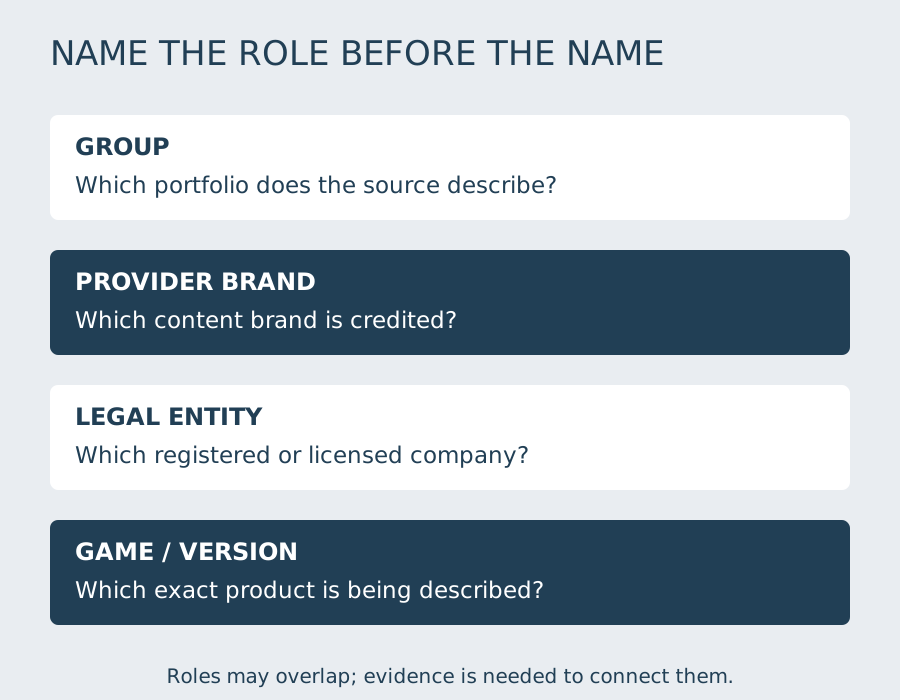
How to check which studio made a casino game and whether it is GB-licensed
A method for confirming the studio credited on a casino game, separating brand from legal entity, and checking the licence and testing records that actually apply.
Read How to check which studio made a casino game and whether it is GB-licensed
Continue reading
What is the least rigged game in a casino?: what the documentation establishes
No document ranks casino games by how rigged they are. The GB licensing papers establish something narrower and more useful: a licensed game must publish its rules and its house edge, and settle by them. Read field by field.
Read What is the least rigged game in a casino?: what the documentation establishesA studio’s RTP range does not identify the version in your casino
Follow a return-to-player claim from a dated supplier statement to the rules for one game version, without treating a catalogue range as a live operator setting.
Read A studio’s RTP range does not identify the version in your casinoWhen a casino game studio is bought, which records actually change?
The Big Time Gaming acquisition shows why an agreement, a completed transaction, a surviving brand and a game version need separate records.
Read When a casino game studio is bought, which records actually change?Build a software research checklist
Build a studio dossier from dated documents
Who makes online casino games: fifteen studios recorded from their own pages and the GB register
How to check which studio made a casino game and whether it is GB-licensed
A studio’s RTP range does not identify the version in your casino
When a casino game studio is bought, which records actually change?
What is the least rigged game in a casino?: what the documentation establishes