Facts checked Article
Casino software studios
A studio’s RTP range does not identify the version in your casino
Follow a return-to-player claim from a dated supplier statement to the rules for one game version, without treating a catalogue range as a live operator setting.
Record the version before you record the percentage
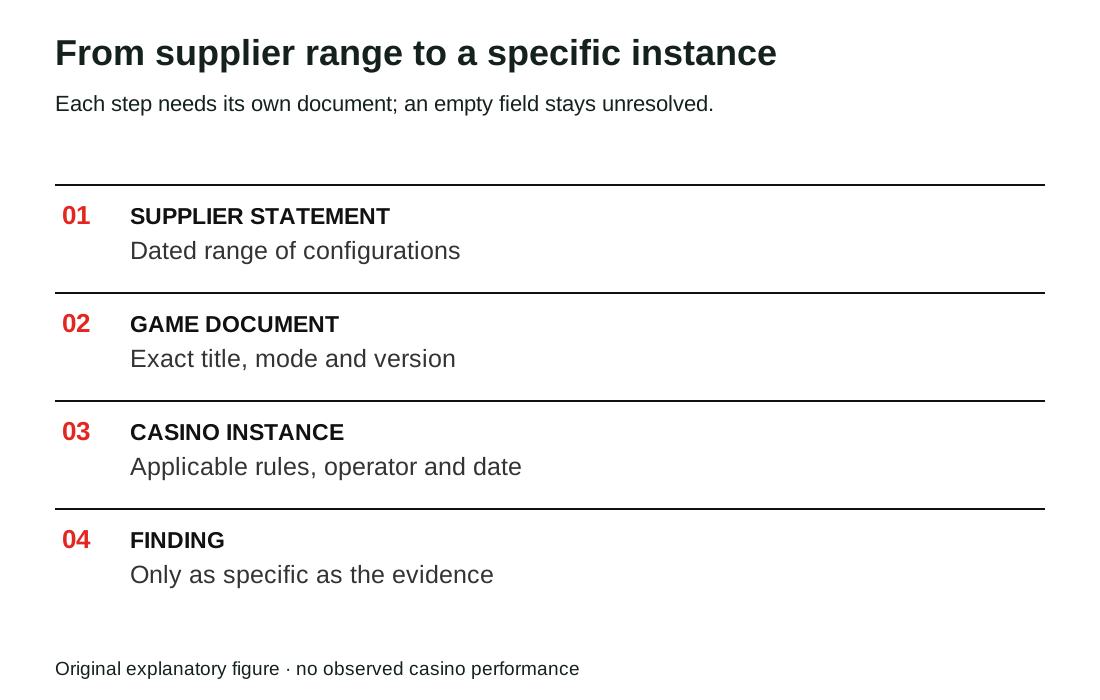
A supplier can describe several return-to-player configurations without telling you which one a particular online casino currently presents. The missing link is the game-specific record: the exact title, rules, displayed percentage, operator and date. A supplier range is evidence about that supplier’s published offering.
It is not, by itself, evidence about the version available in your account.
That distinction matters when a familiar game appears in two places with different documentation. Start by preserving the wording attached to each instance, rather than assuming one percentage must be a mistake. This article examines documents, not game outcomes.
No casino account was opened, no game session was measured and no operator configuration was inspected.
The method is a configuration ledger. Give every claim an object, a source and a date, then ask whether the next document refers to that same object. A studio announcement, a game rules panel and a testing record may each be accurate while describing different levels of the product.
Sources: the-home-of-more | Play'n GO; Remote gambling and software technical standards (RTS) - RTS 3 – Rules, game descriptions and the likelihood of winning.
Ledger header — the supplier statement and the record it does not identify
- Supplier statement
- Play’n GO’s article The Home of More is dated 1 March 2021. It describes five certification targets: 96%, 94%, 91%, 87% and 84%, with a qualification that the figures may vary slightly by region.the-home-of-more | Play'n GO · as checked on
- Retrieval date
- The page was retrieved for this article on 19 September 2026; retrieval does not turn its 2021 description into a newly issued product specification.the-home-of-more | Play'n GO · as checked on
- The game-specific record
- The exact title, rules, displayed percentage, operator and date. A supplier range is evidence about that supplier’s published offering, not about the version available in your account.Remote gambling and software technical standards (RTS) - RTS 3 – Rules, game descriptions and the likelihood of winning · as checked on
- Selected configuration
- The page does not identify a selected configuration at a named casino. The worked record leaves that field unresolved.the-home-of-more | Play'n GO · as checked on
- Research boundary
- This article examines documents, not game outcomes. No casino account was opened, no game session was measured and no operator configuration was inspected.Remote gambling and software technical standards (RTS) - RTS 3 – Rules, game descriptions and the likelihood of winning · as checked on
Field, value, source, date. Nothing in this box identifies a live operator setting.
What the Play’n GO statement actually dates
Play’n GO’s article The Home of More is dated 1 March 2021. It describes five certification targets: 96%, 94%, 91%, 87% and 84%, with a qualification that the figures may vary slightly by region. That establishes a dated supplier statement about multiple RTP levels.
The page was retrieved for this article on 19 September 2026; retrieval does not turn its 2021 description into a newly issued product specification.
The distinction belongs in the ledger itself. Put 1 March 2021 in the document-date column and 19 September 2026 in the retrieval column. Label the claim as historical supplier documentation.
Do not silently give every present-day game all five exact percentages, or infer that each configuration is available in Great Britain.
The page does not identify a selected configuration at a named casino. Our worked record therefore leaves that field unresolved. This is a useful finding: the source answers whether the supplier has described alternative levels, while leaving the player’s more specific version question open.
Sources: the-home-of-more | Play'n GO.
Keep three product questions separate
The studio credit asks who produced or supplied the game. The version record asks which product documentation applies. The casino rules ask what information is being presented at the point of access.
Recording one does not automatically settle the other two.
The Commission’s gambling-software guidance separates the software activity from the provision of facilities for gambling. A software licence alone does not authorise the latter. This is why a developer name, however familiar, should not replace the operator field in a configuration record.
Equally, an operator name is not a precise identifier for every game it offers.
Use the game’s exact spelling and any visible release or version identifier. If none is displayed, write that none was recorded; do not manufacture one from a launch year or filename. Preserve the full rules URL when it is available, along with the route used to reach it.
These are research instructions, not a claim that every provider exposes an identical menu or identifier.
Sources: What is gambling software?; Remote gambling and software technical standards (RTS) - RTS 3 – Rules, game descriptions and the likelihood of winning.
How to build the configuration ledger
The method the prose describes, in order. It is a documents exercise; no wager is needed to complete it.
Give every claim an object, a source and a date
A studio announcement, a game rules panel and a testing record may each be accurate while describing different levels of the product. Ask whether the next document refers to that same object.
Record the game instance
Preserve the wording attached to each instance: the exact title, rules, displayed percentage, operator and date. Use the game’s exact spelling and any visible release or version identifier.
Record that no identifier was displayed
If none is displayed, write that none was recorded; do not manufacture one from a launch year or filename. Preserve the full rules URL when it is available, along with the route used to reach it.
Separate the document date from the retrieval date
Put 1 March 2021 in the document-date column and 19 September 2026 in the retrieval column. Label the claim as historical supplier documentation.
Keep the three product questions apart
The studio credit, the version record and the casino rules ask different questions. Recording one does not automatically settle the other two.
What the result means
The ledger is complete when every conclusion has a matching record and every remaining gap is visible. An unresolved row is a boundary on the research, not an invitation to estimate.
Locate the applicable rule, not a search-result percentage
RTS 3C requires information about the likelihood of winning to be easily available before a customer commits to gamble. Its framework includes the game explanation and information such as house edge, RTP or outcome probabilities, with qualifications for different types of game. It does not require every game to display every possible measure in the same format.
For an RTP claim, transcribe the label and its surrounding conditions. Is it a theoretical figure? Does it refer to a particular mode, feature or game configuration?
Record what the document actually distinguishes. A number detached from its heading can lose the very condition needed to interpret it.
If the accessible rules do not settle the selected version, stop the comparison there. A search snippet, an undated third-party table or a different casino’s help page cannot fill that gap by resemblance. The open question can be sent to the operator through its official support route, with the document link and exact wording.
There is no need to place a wager to make that documentary enquiry.
Rules panel — what to transcribe beside the figure
RTS 3C requires information about the likelihood of winning to be easily available before a customer commits to gamble. It does not require every game to display every possible measure in the same format.
Ticks are kept only in this browser and are never sent anywhere.
Use a ledger that permits an unresolved row
The table is an original evidence comparison, not an operator ranking. Its first row is based on the retrieved supplier page. The remaining rows describe the records needed to move from that broad statement to a claim about a particular deployment.
“Not inspected” is a positive boundary on the research, rather than an invitation to estimate.
Consider a wholly invented document pair. A supplier sheet lists configurations A and B. A casino’s rules explicitly identify B.
If the documents concern the same game and market, the rules support a claim about B at that recorded time; the existence of A does not establish that the casino also offers A. If the rules merely repeat the game name, selection remains unknown.
This example deliberately uses letters. It shows the matching operation without attributing an invented percentage to a real product. The useful conclusion is a document relationship, not a promise about a session or a recommendation to choose a casino.
| Record | What it establishes | What remains open |
|---|---|---|
| Play’n GO, 1 March 2021 | Supplier described five RTP targets | Current title and GB availability |
| Exact game rules | The scope of a displayed figure | Not inspected for a named deployment |
| Version identifier | A way to match product documents | No live version collected |
| Operator and domain | Where the instance is offered | No operator setting inferred |
| Change or testing record | Evidence for a specified update | No certificate or change record inspected |
Sources: the-home-of-more | Play'n GO; Remote gambling and software technical standards (RTS) - RTS 3 – Rules, game descriptions and the likelihood of winning.
Different configurations are not permission to adapt during play
A record of alternative configurations must not be rewritten as evidence that an online game changes its probabilities in response to a player’s losses. RTS 7A prohibits adaptive behaviour. RTS 7D separately addresses changes to rules, payouts and probabilities while a game is available, including changes allowed by the rules and the need to bring changes to customers’ attention.
The implementation guidance describes taking a game offline or suspending it for relevant changes, and notifying customers. It also recognises specified changes within legitimate game rules, such as properly described bonus rounds. That context prevents the shorthand claim that no game parameter can ever vary.
For the ledger, a claim that a deployment changed needs evidence of the earlier and later states. Two conflicting undated webpages do not establish a sequence. Nor does a run of results identify a software update.
Keep a suspected document mismatch separate from an allegation about adaptive behaviour; they require different evidence and should not borrow certainty from one another.
Sources: Remote gambling and software technical standards (RTS) - RTS 7 – Generation of random outcomes.
A changed screen and a changed game are different records
The Commission’s testing strategy classifies updates by their potential effect on fairness. Major changes require external retesting by an approved test house. Minor changes do not affect fairness and may be released without that external retest.
The annex gives examples rather than a visual checklist for players.
Its distinction is useful for document research: a new graphic does not prove the game mathematics changed, while a change to the software implementation of rules may matter even if the written rules look familiar. Neither conclusion can be reached simply from a new loading screen or a familiar game title.
When a certificate is available, retain the product and version it names and the scope it covers. This article has not inspected a certificate for a named RTP configuration. That prevents us from describing any particular present-day deployment as independently verified.
A supplier’s general certification statement and an exact product report remain different evidence items.
Terms used in this dossier
- RTP
- Return to player: the theoretical share of stakes a game is designed to return. The figure shown depends on which configuration is selected.
- House edge
- The game’s built-in margin over the player, one of the measures RTS 3C names alongside RTP and outcome probabilities.
- RTS
- The Commission’s remote gambling and software technical standards. RTS 3 covers game information; RTS 7 covers random outcomes.
- Configuration
- One documented setting of a game, such as one of several RTP levels a supplier describes.
- Adaptive behaviour
- A game changing its probabilities in response to a player’s results, which RTS 7A prohibits.
- Test house
- An approved external body that retests a game after a major change to its fairness-relevant parts.
Write the finding at the narrowest supported scope
A defensible finding from this research is that Play’n GO published a dated description of multiple RTP targets, while the material inspected here does not identify a selected version at any named casino. That sentence retains the source’s value without extending it into a deployment audit.
For your own record, keep the copied percentage beside its title, mode, market, document date and retrieval date. If a later check differs, preserve both observations and explain which field changed. Replace a conclusion only when new evidence answers the same question at a more appropriate scope.
The ledger is complete when every conclusion has a matching record and every remaining gap is visible. It does not need a claim about which game is better, a predicted return or a test session. Gambling can cause harm; a documentary comparison provides no reason to extend play or increase spending.
Sources: the-home-of-more | Play'n GO.
What the documentation establishes, and what it does not
Keep the copied percentage beside its title, mode, market, document date and retrieval date. If a later check differs, preserve both observations and explain which field changed.
Ticks are kept only in this browser and are never sent anywhere.
Questions answered
How do I tell which studio made a game?
Start with the specific game credit and supporting provider documentation. For a configuration question, also keep the exact game rules and any visible version identifier; the studio name alone does not identify the selected RTP.
Can the same studio describe more than one RTP?
Yes. Play’n GO’s 1 March 2021 supplier article described five target levels. That historical statement does not identify the current configuration of a named game at a named casino.
Does a supplier’s highest listed RTP apply everywhere?
The range alone does not establish that. Match the figure to the rules and conditions of the particular game instance; leave the result unresolved if that evidence is missing.
Can a casino change probabilities because I have been losing?
RTS 7A prohibits adaptive behaviour in the remote games it covers. The existence of alternative documented configurations is not evidence that probabilities change in response to an individual’s results.
Does every visual update require a new external game test?
The Commission’s distinction turns on potential effects on fairness. Its testing annex requires external retesting for major changes and distinguishes minor changes that do not affect fairness.
What should a configuration record contain?
The exact title, rules, displayed percentage, operator and date. Use the game’s exact spelling and any visible release or version identifier; if none is displayed, write that none was recorded.
Can two undated webpages show that a game was changed?
No. A claim that a deployment changed needs evidence of the earlier and later states; two conflicting undated webpages do not establish a sequence, and a run of results does not identify a software update.
Original documentation
- the-home-of-more | Play'n GO
- Remote gambling and software technical standards (RTS) - RTS 3 – Rules, game descriptions and the likelihood of winning
- What is gambling software?
- Remote gambling and software technical standards (RTS) - RTS 7 – Generation of random outcomes
- Testing strategy for compliance with remote gambling and software technical standards - Annex A - Major and minor game and software updates
Continue reading

Build a studio dossier from dated documents
A useful studio profile answers a narrow question: who publishes this game, what entity is named in the documentation, and when was that information current?
Read Build a studio dossier from dated documents
What are the leading suppliers of online slot games? What the published test reports establish
No UK regulator ranks slot studios. The Gambling Commission lists 14 approved test houses and sets the fields every game test report must name, both read 23 September 2026.
Read What are the leading suppliers of online slot games? What the published test reports establish
When a casino game studio is bought, which records actually change?
The Big Time Gaming acquisition shows why an agreement, a completed transaction, a surviving brand and a game version need separate records.
Read When a casino game studio is bought, which records actually change?
What is the least rigged game in a casino?: what the documentation establishes
No document ranks casino games by how rigged they are. The GB licensing papers establish something narrower and more useful: a licensed game must publish its rules and its house edge, and settle by them. Read field by field.
Read What is the least rigged game in a casino?: what the documentation establishes
Who makes online casino games: fifteen studios recorded from their own pages and the GB register
Fifteen studios that make online casino games, recorded only from their own published pages and the Gambling Commission register: entities, licences, certification wording, each dated 18 September 2026.
Read Who makes online casino games: fifteen studios recorded from their own pages and the GB register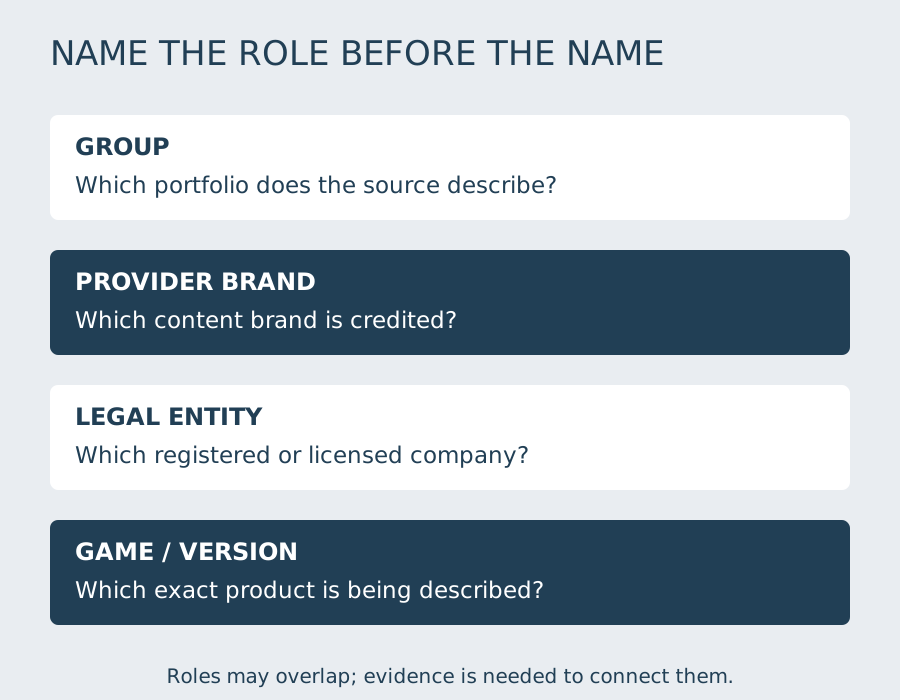
How to check which studio made a casino game and whether it is GB-licensed
A method for confirming the studio credited on a casino game, separating brand from legal entity, and checking the licence and testing records that actually apply.
Read How to check which studio made a casino game and whether it is GB-licensed
Continue reading
What is the least rigged game in a casino?: what the documentation establishes
No document ranks casino games by how rigged they are. The GB licensing papers establish something narrower and more useful: a licensed game must publish its rules and its house edge, and settle by them. Read field by field.
Read What is the least rigged game in a casino?: what the documentation establishesWhen a casino game studio is bought, which records actually change?
The Big Time Gaming acquisition shows why an agreement, a completed transaction, a surviving brand and a game version need separate records.
Read When a casino game studio is bought, which records actually change?Build a studio dossier from dated documents
A useful studio profile answers a narrow question: who publishes this game, what entity is named in the documentation, and when was that information current?
Read Build a studio dossier from dated documentsBuild a software research checklist
Build a studio dossier from dated documents
What are the leading suppliers of online slot games? What the published test reports establish
Who makes online casino games: fifteen studios recorded from their own pages and the GB register
How to check which studio made a casino game and whether it is GB-licensed
When a casino game studio is bought, which records actually change?
What is the least rigged game in a casino?: what the documentation establishes