Facts checked Article
Casino software studios
When a casino game studio is bought, which records actually change?
The Big Time Gaming acquisition shows why an agreement, a completed transaction, a surviving brand and a game version need separate records.
An acquisition updates ownership evidence first
A casino game studio being bought does not, by itself, tell you that the rules of your game have changed. It establishes a corporate event, provided the evidence shows that the transaction completed. A player investigating a familiar slot after an acquisition needs a second record for the product: its displayed studio credit, rules and version, wherever a version is supplied.
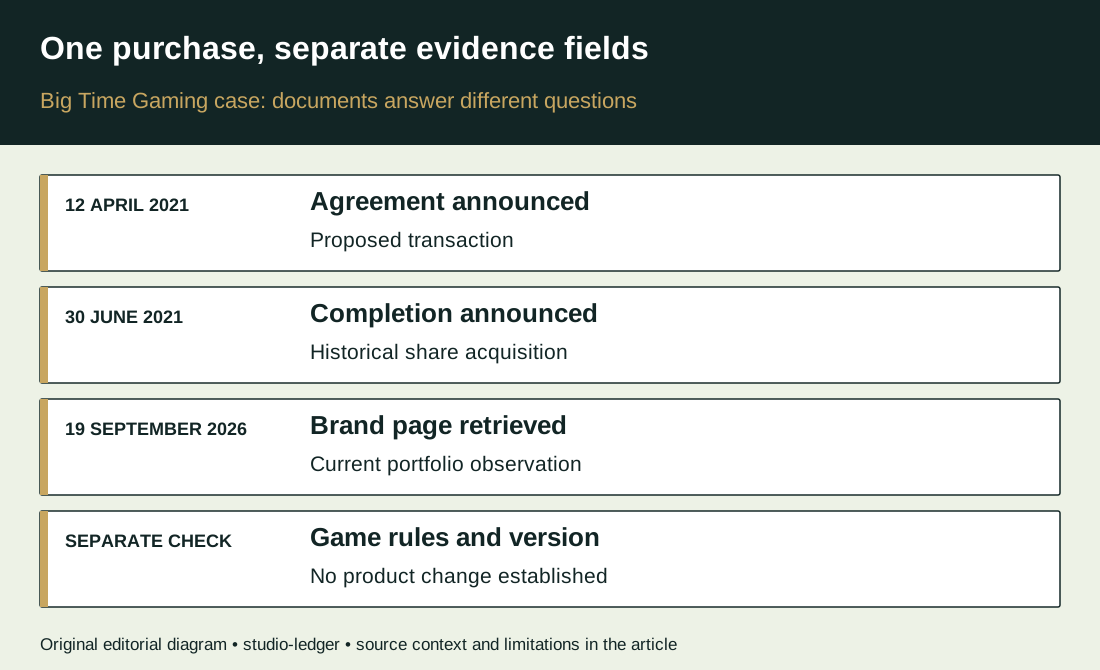
Big Time Gaming provides a useful documented case. Evolution announced an agreement on 12 April 2021, then announced completion on 30 June 2021. Those are two different milestones. A note written between them should not silently treat the proposed purchase as a finished one. A note written today should preserve both historical dates rather than replace them with today's research date.
This article uses a claim ledger: one proposition per row, with a document, an event date and a limit on what follows. It is a documentary method for an online casino reader, not a review of game quality. No account was opened and no game was played for this research. The conclusions concern the records retrieved on 19 September 2026.
Sources: Evolution has entered into an agreement to acquire leading online slot machine developer Big Time Gaming; Evolution completes acquisition of Big Time Gaming and issues shares to the sellers.
Read the April agreement in its own tense
Evolution's April release describes an agreement to acquire the entire issued share capital of Big Time Gaming Pty Ltd. It also describes the proposed consideration and the transaction's rationale. Those details belong to the proposed deal at that point in time. They do not give the reader permission to rewrite every Big Time game credit as Evolution.
The useful research question is narrower than whether the announcement sounds decisive. Does the document describe an agreement, an offer, an approval or completion? Copy the event category into the ledger before summarising it. An expected completion date remains an expectation until supported by another record. A company describing why it wants a studio is also expressing its own strategic view, not an independent assessment of the studio's products.
For this case, the ledger's April row can say that Evolution announced the agreement. It cannot stand alone as evidence that ownership had already transferred on that date. That distinction prevents a common chronology error when older news is reused in a fresh provider profile. Keep the title and exact corporate names alongside the date so that a later researcher can identify the same transaction.
Completion closes one question, not every question
The June release says the conditional regulatory approvals had been received and that Evolution had completed the transaction and acquired the shares. This supplies the missing completion evidence. It is a company announcement of a historical share acquisition, rather than a present-day inspection of a casino lobby or a regulator's approval of a particular game.
The appropriate update is therefore specific: add the completed acquisition and its date to the ownership history. Keep the earlier announcement as the preceding event. Do not overwrite the earlier row, because the difference between the records explains why two apparently conflicting dates may appear in otherwise accurate accounts.
Imagine a hypothetical research notebook with three fields: owner, credited studio and rules version. The completion notice supports an ownership-history update. It supplies no observed replacement value for the other two fields. Leaving them unchanged as historical observations, with their original observation dates, is more accurate than filling them with the buyer's name. If their current state matters, inspect their current documents separately. This is an evidence gap, not proof that the game either changed or stayed identical.
Sources: Evolution completes acquisition of Big Time Gaming and issues shares to the sellers.
A surviving brand is a different kind of record
Evolution's retrieved portfolio page continues to identify Big Time Gaming as a named brand. That gives a reader a contemporary portfolio observation alongside the historical transaction. It does not make the brand name interchangeable with every legal entity in the group, and it does not identify which entity contracts with a particular player.
Use separate wording for the separate facts. A historical sentence can date the acquisition. A current observation can say that the portfolio page lists the brand when checked. A game record can preserve the studio credit printed in that game's documentation. Each statement has a different object and may need a different source.
This is especially useful when searching old game material. Searching only the acquiring company's name can miss a product that is still described under its original studio brand. Conversely, finding a familiar brand does not establish that its ownership history stopped at the date of the game's release. The research method is to retain both names in their proper fields. It is not to decide that one is the real name and erase the other.
Sources: Brands.
The software role still needs its own evidence
The Gambling Commission's software guidance describes activities involved in manufacturing, supplying, installing or adapting gambling software. That is a different question from who owns shares in a studio. A corporate announcement should not be used as a substitute for checking the activity and entity relevant to a particular software claim.
For an online casino reader, the distinction is practical. The name on the game, the company supplying software and the operator holding the player account can occupy different lines in the evidence file. A purchase of a studio does not itself tell the reader where to send an account complaint or which website's terms govern a deposit. Those conclusions require the account operator's documents.
In the ledger, mark a licence field as unverified unless the relevant official record has actually been examined. Do not copy a group-level badge into every subsidiary row. Equally, do not infer a licensing problem merely because the branding and legal name differ. The useful output is a precise question about the entity and activity, followed by a record that answers it. This article does not undertake that licence check for Big Time Gaming.
Sources: What is gambling software?.
Use the game rules to investigate a product change
RTS 3 addresses the availability of rules, game descriptions and information about the likelihood of winning. It supplies the regulatory context for looking at the actual game information. An acquisition announcement is not one of those game-specific records. If the question is whether a payout table or stated return changed, the evidence must concern those particular terms.
A repeatable comparison records the game title, the casino route, the market context, the rules text, the date and any version identifier displayed. If there is an earlier saved copy, compare equivalent fields. An older promotional page and a current in-game rules panel may describe different scopes; their disagreement is a reason to investigate, not an automatic finding of a change.
No before-and-after game rules were collected here, so this research cannot attribute an RTP change, altered prize structure or different experience to the acquisition. It also cannot establish that none occurred. Readers researching slot mechanics can use Reel & Story's explanation of RTP and a session; the task here stops at identifying which document could support the product claim.
Sources: RTS 3 – Rules, game descriptions and the likelihood of winning.
A worked ledger for the Big Time Gaming case
The comparison below deliberately keeps the company statements short. Its value lies in the empty implications: the records establish corporate events and a portfolio listing, while leaving specific game and player-account questions unanswered. That is a useful result. A dossier does not become stronger by turning missing evidence into a confident assertion.
Apply the same method to a hypothetical reader question: did my game's provider change when I noticed a new group name? First separate the date the reader noticed the name from the transaction date. Then ask what actually changed on the page: the studio credit, a copyright line, a legal notice or a group logo. These observations should occupy separate rows, even if they appeared together.
Only then compare the observations with the corporate documents. A matching acquisition can explain why two names appear in a provider history, but it does not prove the cause of every interface change. The ledger records that causal limit explicitly. If a rules version is missing, write that it was not supplied in the inspected material. Do not invent an identifier merely to complete the table.
Sources: Evolution has entered into an agreement to acquire leading online slot machine developer Big Time Gaming; Evolution completes acquisition of Big Time Gaming and issues shares to the sellers; Brands.
| Record | Supported conclusion | Does not establish |
|---|---|---|
| 12 April 2021 agreement | Evolution announced an agreement to acquire Big Time Gaming Pty Ltd | Completion on the announcement date |
| 30 June 2021 completion | Evolution announced completion and acquisition of the shares | A changed game version or payout table |
| Evolution brands page, retrieved 19 September 2026 | Big Time Gaming remains a named portfolio brand | The operator of an individual player account |
| No before/after game-rule pair collected | Product changes remain unverified | That all games changed, or all stayed identical |
Keep a correction trail that survives the next purchase
Save the original wording of each conclusion along with the document used to reach it. When new evidence arrives, add a dated update describing what it changes. A completed transaction can replace a pending conclusion without making the earlier pending observation wrong. The two entries describe different moments.
For a compact provider note, use four headings: ownership history, current brand observation, product record and unresolved questions. Attach retrieval dates to sources and event dates to transactions. A page checked today can accurately describe a transaction completed years ago; those dates should never be collapsed into one freshness label.
The resulting note should answer a bounded question. In this case, the two Evolution releases distinguish agreement from completion, and the portfolio page preserves Big Time Gaming as a named brand at retrieval. No claim is made about a specific casino's game configuration, account migration, staff continuity or future availability. Those would require additional evidence. Keep this ledger beside Studio Ledger's provider index when an acquisition story introduces another name into an otherwise familiar game record.
Questions answered
How do I tell which studio made a game?
Start with the studio credit and rules attached to that game, then record the group relationship separately. An acquisition announcement cannot replace a product credit.
Who makes online casino games?
Studios and software suppliers develop casino content, while the account operator is a separate role to identify. This case concerns ownership of one studio, not a ranking of suppliers.
Did Evolution announce and complete the Big Time Gaming deal on the same day?
No. Its cited releases are dated 12 April 2021 for the agreement and 30 June 2021 for completion.
Does the purchase mean the game rules changed?
That does not follow from the acquisition documents. Compare dated rules for the same product and configuration before making a product-change claim.
Is the current brand page enough to reconstruct ownership history?
No. It is evidence of how the portfolio is presented when retrieved; dated transaction documents establish the historical milestones.
Original documentation
Continue reading

Build a studio dossier from dated documents
A useful studio profile answers a narrow question: who publishes this game, what entity is named in the documentation, and when was that information current?
Read Build a studio dossier from dated documents
What are the leading suppliers of online slot games? What the published test reports establish
No UK regulator ranks slot studios. The Gambling Commission lists 14 approved test houses and sets the fields every game test report must name, both read 23 September 2026.
Read What are the leading suppliers of online slot games? What the published test reports establish
A studio’s RTP range does not identify the version in your casino
Follow a return-to-player claim from a dated supplier statement to the rules for one game version, without treating a catalogue range as a live operator setting.
Read A studio’s RTP range does not identify the version in your casino
What is the least rigged game in a casino?: what the documentation establishes
No document ranks casino games by how rigged they are. The GB licensing papers establish something narrower and more useful: a licensed game must publish its rules and its house edge, and settle by them. Read field by field.
Read What is the least rigged game in a casino?: what the documentation establishes
Who makes online casino games: fifteen studios recorded from their own pages and the GB register
Fifteen studios that make online casino games, recorded only from their own published pages and the Gambling Commission register: entities, licences, certification wording, each dated 18 September 2026.
Read Who makes online casino games: fifteen studios recorded from their own pages and the GB register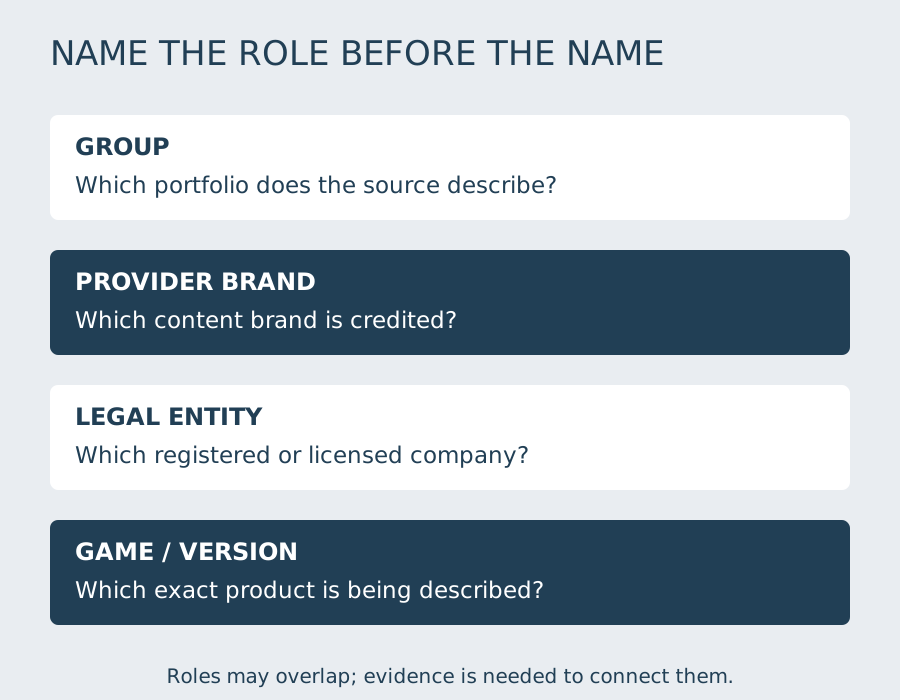
How to check which studio made a casino game and whether it is GB-licensed
A method for confirming the studio credited on a casino game, separating brand from legal entity, and checking the licence and testing records that actually apply.
Read How to check which studio made a casino game and whether it is GB-licensed
Continue reading
What is the least rigged game in a casino?: what the documentation establishes
No document ranks casino games by how rigged they are. The GB licensing papers establish something narrower and more useful: a licensed game must publish its rules and its house edge, and settle by them. Read field by field.
Read What is the least rigged game in a casino?: what the documentation establishesA studio’s RTP range does not identify the version in your casino
Follow a return-to-player claim from a dated supplier statement to the rules for one game version, without treating a catalogue range as a live operator setting.
Read A studio’s RTP range does not identify the version in your casinoBuild a studio dossier from dated documents
A useful studio profile answers a narrow question: who publishes this game, what entity is named in the documentation, and when was that information current?
Read Build a studio dossier from dated documentsBuild a software research checklist
Build a studio dossier from dated documents
What are the leading suppliers of online slot games? What the published test reports establish
Who makes online casino games: fifteen studios recorded from their own pages and the GB register
How to check which studio made a casino game and whether it is GB-licensed
A studio’s RTP range does not identify the version in your casino
What is the least rigged game in a casino?: what the documentation establishes