Core guide
Who makes online casino games? A guide to providers, brands and evidence
Trace Evolution, NetEnt, Red Tiger and Play’n GO through the right records, separating a content brand from a legal entity, game version and casino operator.
Start with the role the reader is trying to identify
“Who makes this casino game?” can mean who created its content, which brand distributes it, which company holds a relevant licence or which operator offers it to customers. Those questions may lead to different names. A useful provider profile explains the relationship instead of treating the first logo as the whole answer.
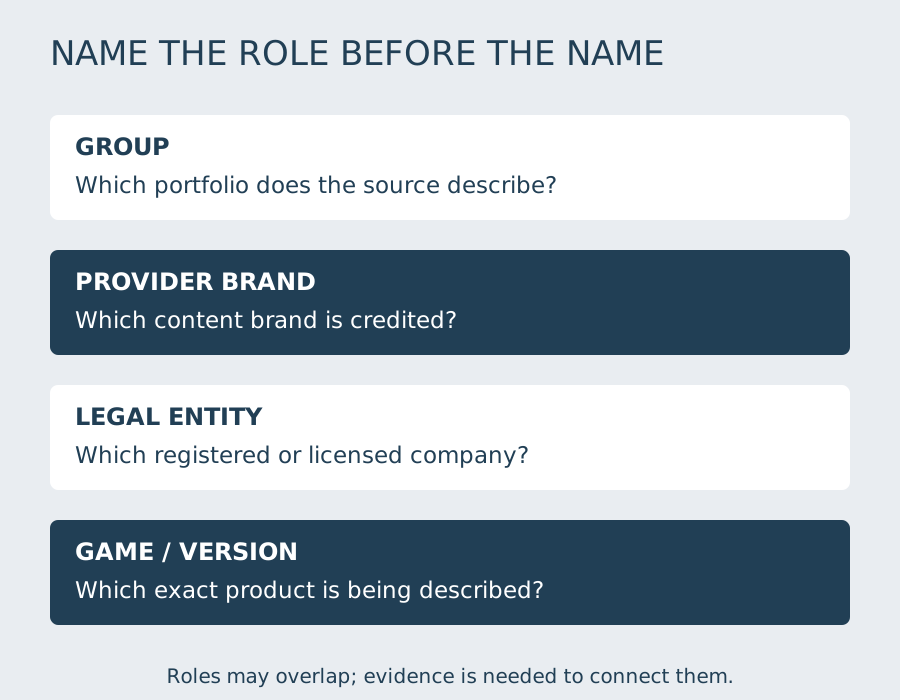
Studio Ledger uses four starting fields: group, provider brand, legal entity and exact game title or version. These are research categories, not a claim that every business follows the same organisational structure. One company may perform several roles, while several companies may contribute to a product.
The original diagram keeps the fields separate. An evidence link between two boxes needs a source that actually makes the connection. Similar typography, a shared website footer or an appearance in the same casino lobby is not enough to infer every relationship.
This guide examines public documents, using Evolution and Play’n GO as real examples. It does not rank their games, certify a casino or claim access to private contracts. Its practical purpose is to make a provider dossier specific enough that another reader can check what each entry means.
Evolution, NetEnt and Red Tiger: read the portfolio as a portfolio
Evolution’s official brands page lists several content brands, including NetEnt, Red Tiger, Ezugi and Big Time Gaming. It describes different areas of activity, including live casino, slots and game mechanics. A reader can therefore identify a group-level portfolio and then follow a named brand to the relevant content.
That is different from saying that every title is produced by the same team or uses the same underlying game rules. A portfolio relationship does not erase the title-specific credits or product documentation. Nor does it mean every casino offering one brand automatically offers the others.
Use a two-level entry when the source supports it. The group field records the portfolio context. The brand field records the name credited for the particular product. Keeping both avoids the common mistake of replacing a familiar game-credit name with a broader corporate label and losing useful specificity.
For a historical dossier, add a date to the relationship. A current portfolio page describes the current retrieved record; it is not evidence that the same arrangement existed at a game’s original launch. A historical claim needs a dated announcement or corporate record relevant to that earlier period.
Sources: Evolution: Official brands portfolio.
Play’n GO: a supplier description does not identify the customer’s operator
Play’n GO’s official about page describes its role supplying games to casino operators and identifies Rich Wilde and the Book of Dead within its portfolio. This is a useful direct source for a provider-level entry. It is not a statement that Play’n GO operates every casino displaying one of those games.
The page also names legal entities in its regulatory footer. That illustrates why the brand and entity fields should remain distinct. A brand name is useful for finding content; a legal entity name is needed when checking a specific company or licence record.
Suppose a reader sees a Play’n GO title inside a named casino. The game credit helps identify the content supplier. It does not answer which business holds the customer account, what withdrawal rules apply or which complaints route concerns that account. Those belong to the operator’s documents.
A good provider profile can state this relationship in ordinary language: this is the content brand, this is the exact title being discussed, and the casino account is a separate relationship. That short distinction often answers a branded search more usefully than a long list of casinos carrying the provider’s logo.
Sources: Play’n GO: About us.
Software permission and operator permission are different questions
The Gambling Commission’s software guidance distinguishes manufacturing, supplying, installing or adapting gambling software from providing facilities for gambling. A software licence alone does not authorise every activity that might appear elsewhere in a gambling business. Additional operating permissions can be relevant to a different role.
For a research record, retain the exact activity attached to an entity rather than reduce everything to “licensed”. The word is incomplete without the regulator, entity, activity and relevant status or date. A licence for one role should not be silently described as approval of another role.
The same care applies to the word platform. It may describe a technical service in one document and a customer-facing business in another. Define the role that the source actually assigns instead of assuming the term always means the same thing.
This is an explanation of how to read records, not a legal determination about a particular business arrangement. The Commission’s guidance itself recognises that it cannot cover every scenario. An unresolved entity or role match should remain unresolved until the relevant source supplies it, rather than being inferred from a screenshot or a generic brand page.
Sources: UK Gambling Commission: What is gambling software?.
A product dossier needs a title, a version and a market context
Our studio dossier note gives the compact foundation. For a fuller record, add the exact title, provider credit, source address, release information and any version identifier. Preserve punctuation and meaningful suffixes: a feature edition or sequel can be a different product rather than an alternative spelling.
Then separate a product release from an operator launch. A provider can announce a game globally while an operator announcement describes a later introduction in one market. Those dates answer different questions. Neither should overwrite the other in a single undifferentiated launch-date field.
An invented timeline makes the distinction clear. A studio announces a title on 5 May. A named operator announces it for one market on 20 June. A researcher observes a public information page on 2 July. The first is a product announcement, the second a distribution announcement, and the third an observation date. The record does not establish availability in every market between those dates.
Keep exclusions visible. A release statement may name only selected jurisdictions or platforms. Removing that qualification can turn an accurate announcement into an inaccurate universal claim. If the question is UK availability, a launch elsewhere is background information rather than the answer.
Read a testing claim at the scale of the test
A test certificate or laboratory statement has a scope. Useful fields include the issuer, product identifier, version, date, standard or jurisdiction referenced and the function assessed. The document should be read as evidence about that scope rather than a universal seal for every game or account associated with the brand.
Our note on testing evidence explains that boundary in more detail. For a provider dossier, attach the test record to the exact product or system entry it concerns. Do not place it only at the top of a brand page in a way that makes it appear to cover everything below.
Consider an invented certificate for Build A, version 1.2, dated March. A later release note describes Build B, version 2.0. The older certificate may be relevant historical evidence, but the version mismatch needs explanation before it can support a claim about B. A new colour scheme might be superficial; a new rule or payout configuration might be material. The public record must establish which change occurred.
A missing public certificate is not proof that testing never happened. Equally, a laboratory logo without an inspectable scope does not establish what was tested. Those are different limits and should be reported separately.
Build a dossier that survives a future update
Store one claim per record with its supporting source and date. “Brand listed in portfolio”, “entity named in footer” and “game described in product sheet” are more useful entries than one paragraph mixing all three. If one source changes later, the affected claim can be reviewed without rewriting unrelated facts.
The interactive evidence selector helps route five common questions to the appropriate record. It does not query a register or verify a company automatically. Its output identifies what evidence would answer the question and what that evidence would still leave open.
For a practical update, compare the old and new claim text, not merely the page’s design. A redesigned website may preserve the same underlying relationships. A small change in a legal name or product identifier can matter more than a large visual change.
Keep a separate field for uncertainty. If a title credit is clear but the relevant legal entity is not, retain the clear credit and mark the entity question unresolved. Deleting the useful fact or guessing the missing one both reduce the quality of the dossier. Retain the source’s full entity name and identifier together so that similarly named companies are not accidentally merged during a later update.
The result is a provider profile that answers concrete reader questions about Evolution, NetEnt, Red Tiger, Play’n GO or another documented supplier. Its value lies in the connections it can actually substantiate, with enough detail to distinguish content identity from the business running a customer’s casino account.
Choose a provider research question to see which record is needed and its limits.
Questions answered
Is a game provider the same as the casino operator?
Not necessarily. A provider can supply content to an operator that holds the customer account. Identify each role from the relevant documents rather than assume a game logo names the account operator.
Does an Evolution portfolio listing make NetEnt and Red Tiger the same game brand?
No. The official portfolio supplies group context while retaining separate named brands. Keep the specific product credit and rules in the game record.
Does one test certificate cover every later game version?
That cannot be assumed. Check the certificate’s product, version, scope and date, and determine whether later changes are covered by relevant evidence.